
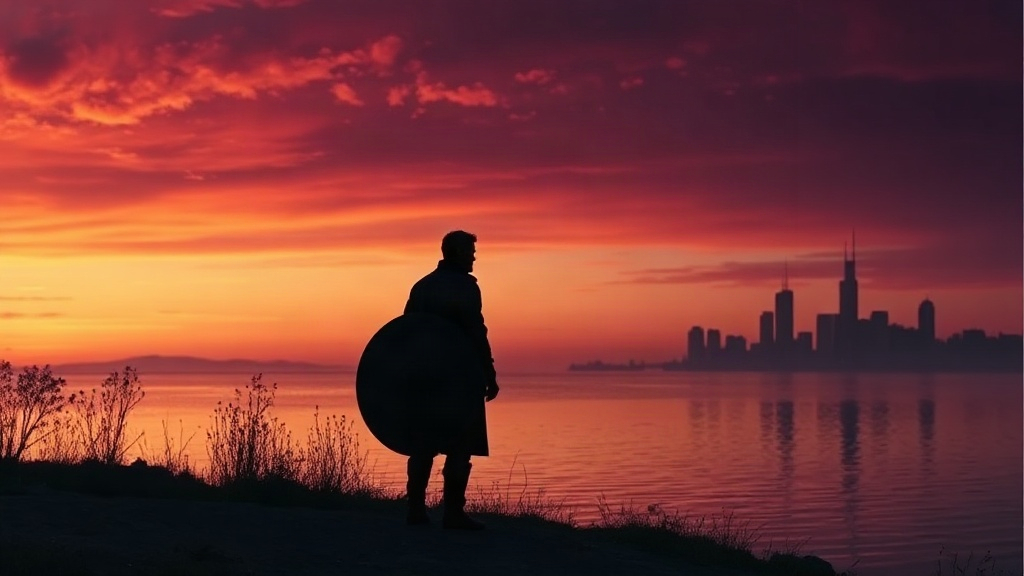
When Avengers: Endgame first hit theaters in 2019, its final moments felt like a definitive farewell. Steve Rogers, having returned the Infinity Stones, chose to stay in the past with Peggy Carter, passing the shield to Sam Wilson. It was a quiet, emotional conclusion to a decade-long journey. But now, with the release of an extended encore version of Endgame, that ending has been subtly but significantly altered. Director Anthony Russo recently discussed the change, and his comments suggest that this new ending isn't just a tweak for nostalgia. It is, in his words, the place where Doomsday is born.
What Exactly Changed in the Endgame Encore?
The encore version, now available in select theaters and on streaming, adds roughly seven minutes to the film's final act. Most of the new footage focuses on the moments after Tony Stark's funeral. We see Steve Rogers standing alone by the lake, the shield in his hand, staring at the water. In the original cut, this scene transitions quickly to his dance with Peggy. In the encore, however, there is an additional exchange with Bruce Banner. Bruce, still nursing his injured arm, asks Steve if he is sure about his decision. Steve's reply is different from what we heard before. Instead of a simple 'I'm ready,' he says, 'I have to see if the world can survive without me. But I also have to see what happens when it doesn't.'
That line, according to Russo, is the key. 'That's where Doomsday is born,' he explained in a recent interview. 'Steve's choice isn't just about personal happiness. It's about testing a theory. He wants to know if the Avengers can function without him, and more importantly, if the world can handle the consequences of his absence. That's a very different Steve Rogers than the one who just wanted to go home.'
Why This Rewrites Steve Rogers' Story
For years, fans have debated the morality of Steve's decision. Some saw it as a well-earned retirement; others felt it was a selfish abandonment of his responsibilities. The encore ending complicates that debate by adding a layer of intentionality. Steve isn't just stepping away; he is conducting an experiment. He is leaving behind a world that still needs him, to see what happens when he isn't there to fix it. That is a much more ambiguous, and arguably more interesting, character choice.
Russo elaborated: 'We always knew that Steve's arc was about duty versus personal desire. But in the encore, we wanted to show that he is aware of the cost. He is not naive. He knows that his absence could lead to catastrophe. But he also believes that the Avengers, and the world, have to learn to stand on their own. That's a burden he carries with him into the past.'
This shift in motivation has ripple effects. It means that the Steve Rogers we see at the end of Endgame is not a man at peace; he is a man who has made a calculated gamble. And that gamble, according to Russo, is what sets the stage for Avengers: Doomsday. 'The Doomsday we are building toward is not just a villain. It's a consequence. It's what happens when you take away the one person who always had a plan,' he said.
How This Connects to Avengers: Doomsday
Avengers: Doomsday, formerly known as Avengers: The Kang Dynasty, has been shrouded in mystery. But Russo's comments provide a crucial piece of the puzzle. If Steve's departure was a test, then the events of Doomsday might be the failure of that test. The film is expected to feature a new threat that emerges from the power vacuum left by the original Avengers. Without Steve Rogers to rally the troops, the remaining heroes may be more fractured, more vulnerable.
This also aligns with earlier rumors that Doomsday will explore the concept of legacy. Sam Wilson's Captain America, in this reading, is not just filling a role; he is dealing with the fallout of Steve's decision. The encore ending suggests that Steve knew this might happen, and he chose to leave anyway. That is a much darker take on the character, and it gives Sam's journey a tragic weight.
Russo hinted that the encore is not just a standalone curiosity. 'We wanted to plant a seed,' he said. 'The encore is canon. It's part of the story we are telling. And it leads directly into Doomsday.' That statement alone has sent shockwaves through the fan community, as it confirms that the extended ending is not a retcon but a deliberate narrative bridge.
The Implications for the MCU's Future
If the encore is canon, then several assumptions about the MCU's timeline need to be revisited. First, Steve's return to the past is now more complex. He didn't just live a quiet life; he lived with the knowledge that his absence might cause harm. That adds a layer of guilt and uncertainty to his later appearances, should he make any. Second, it means that the Avengers' failure in Doomsday could be directly tied to Steve's choice. That is a bold narrative move, one that makes the original team's legacy even more complicated.
It also raises questions about the nature of heroism in the MCU. Steve Rogers was always the moral compass, the one who made the hard calls. But this new ending suggests that even he could be wrong. That fallibility is what makes him human, and it is what makes the stakes of Doomsday feel personal. The film is not just about fighting a new villain; it is about dealing with the consequences of a hero's final decision.
Fan Reactions and the Broader Conversation
As expected, the encore ending has ignited fierce debate online. Some fans appreciate the added depth, arguing that it makes Steve's arc more nuanced and sets up a compelling conflict. Others feel that it tarnishes his happy ending, turning a moment of peace into a moment of doubt. Russo acknowledged this divide: 'We knew it would be controversial. But we also knew that it was necessary. The MCU is not a fairy tale. It's a story about people making difficult choices, and those choices have consequences.'
This debate mirrors larger conversations about legacy and responsibility in superhero narratives. The idea that a hero's retirement could be a catalyst for disaster is not new, but it is rarely explored with such deliberate foreshadowing. By tying Steve's choice to Doomsday, the Russo brothers are asking audiences to reconsider what it means to be a hero. Is it about always being there, or about knowing when to step aside? And what happens when that step aside leads to catastrophe?
FAQ
What is the Endgame encore?
The Endgame encore is an extended version of the film that includes additional footage in the final act, specifically expanding on Steve Rogers' decision to return to the past and setting up future MCU storylines.
How does the new ending rewrite Steve Rogers' story?
The new ending adds dialogue that suggests Steve's choice was a deliberate test to see if the world could survive without him, adding moral ambiguity and a sense of burden to his character arc.
Is the encore ending canon to the MCU?
Yes, director Anthony Russo has confirmed that the encore is canon and directly leads into the events of Avengers: Doomsday.
How does this connect to Avengers: Doomsday?
The encore establishes that Steve's departure may have created a power vacuum that leads to the conflict in Doomsday, making the film a consequence of his decision.
What does this mean for Sam Wilson's Captain America?
It adds tragic weight to Sam's journey, as he must deal with the fallout of Steve's choice and the potential failure of his experiment.