
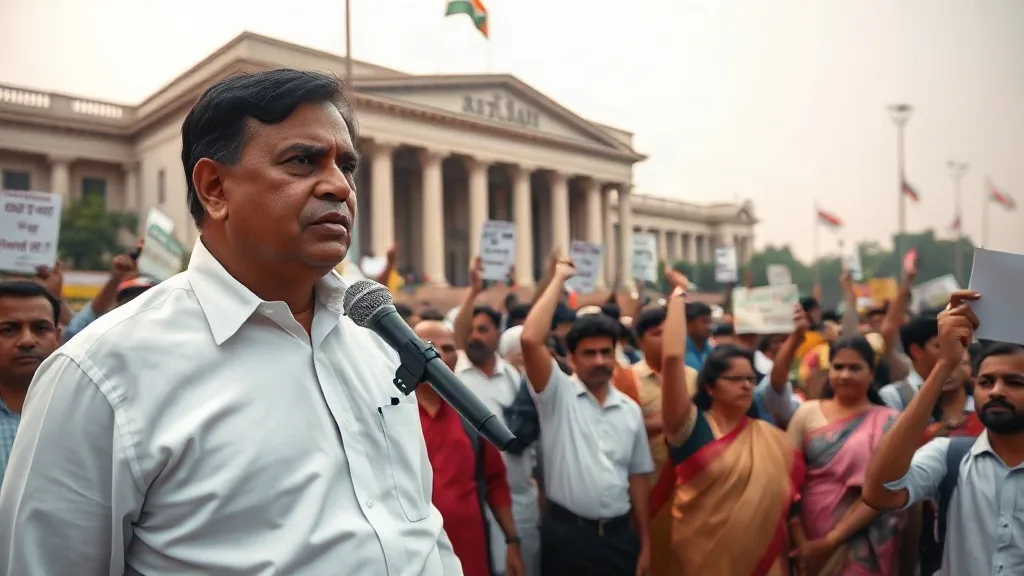
When Thol. Thirumavalavan took the microphone at a recent protest outside the Election Commission of India’s office in New Delhi, he did more than criticise the poll body. His remarks about the Special Intensive Revision (SIR) of electoral rolls and its supposed role in a rival party’s victory have set off a quiet storm inside his own organisation, the Viduthalai Chiruthaigal Katchi (VCK). Party workers and mid-level leaders, who spoke on condition of anonymity, describe a mood that swings between confusion and frustration. The message they heard was not a simple attack on the Bharatiya Janata Party or the ECI. It was a suggestion that the SIR process, which many VCK cadres have been fighting against for months, might have helped a competitor win.
At the heart of the unease is a single, loaded claim: that the recent electoral success of TVK, the party founded by actor Vijay, was somehow tied to the SIR. Thirumavalavan did not present evidence, and the ECI has not commented on his allegation. But the mere airing of such a theory has forced VCK’s ground-level workers to ask an uncomfortable question. If the SIR was flawed and partisan, why would it benefit a party that is not the BJP? And if it was not flawed, why has the VCK spent so much energy opposing it?
The SIR dispute and why it matters
The Special Intensive Revision is an exercise the ECI has described as a routine cleanup of voter rolls. Critics, including the VCK, argue that it disproportionately removes names from marginalised communities, especially Dalits and minorities. For Thirumavalavan, whose political identity is built on defending those very communities, the SIR has been a natural target. His party has staged protests, filed objections, and joined broader opposition coalitions against it. That stance has been consistent for months.
So when he linked the SIR to TVK’s victory, the message landed awkwardly. VCK’s anti-SIR campaign has been one of its most visible political projects in recent years, and any suggestion that the same process could have helped a rival cuts against the party’s own narrative. It also raises doubts about whether the VCK sees TVK as a bigger threat than the BJP in Tamil Nadu’s crowded political landscape.
What exactly did Thirumavalavan say?
According to reports from the protest, Thirumavalavan expressed doubts over TVK’s recent win and attributed its success to the SIR process. He did not elaborate on the mechanism. He did not say whether he believed the SIR was manipulated in TVK’s favour or whether TVK simply benefited from a reduced electorate that happened to suit its support base. That lack of specificity is precisely what has left his cadre guessing.
One senior VCK functionary from the northern districts put it plainly: “We have been telling people that SIR is a weapon against us. Now our own leader says it helped TVK. What do we tell them tomorrow?” The functionary did not want to be named because he is not authorised to speak to the press.
Mixed signals on the ground
For a party that prides itself on ideological clarity, the current moment feels unusually muddled. VCK cadres are used to a binary framework: the BJP and its allies are the opponents, and the SIR is one of their tools. Thirumavalavan’s remarks introduce a third variable. They suggest that the SIR could also be a factor in intra-opposition dynamics, where TVK is not an ally but a competitor for the same anti-establishment space.
That reading is not entirely far-fetched. TVK has positioned itself as a new political force, and its recent electoral showing has unsettled several established parties in Tamil Nadu. For VCK, which draws its support largely from Dalit and marginalised communities, TVK’s rise poses a specific challenge. If TVK can claim to speak for those communities while also appealing to a broader anti-incumbency mood, VCK’s distinct identity could get blurred.
The mixed signal is not just about one speech; it is about how VCK positions itself in a shifting opposition landscape. Some party leaders see Thirumavalavan’s comments as a strategic warning to TVK, a way of saying that VCK will not quietly cede ground. Others worry that it hands ammunition to the BJP, which can now argue that even opposition parties admit the SIR was not uniformly unfair.
The cadre’s dilemma
At the ground level, VCK workers are left to reconcile two conflicting stories. On one hand, they have been trained to see the SIR as an assault on their voter base. On the other, their leader has implied that the same process helped a party they do not consider an ally. The result is a kind of ideological vertigo. Some workers have started asking whether the party’s anti-SIR campaign was ever about principle or simply about electoral advantage. That is a dangerous question for any party that claims to fight for the marginalised.
“We are not against criticising TVK,” a district-level VCK organiser said. “But why bring SIR into it? It makes our own protests look confused.” He added that several local units have sought clarification from the leadership, though no formal communication has been issued yet.
What this means for VCK’s alliances
VCK has long been part of the DMK-led alliance in Tamil Nadu. Its relationship with the DMK is pragmatic, built on seat-sharing and shared opposition to the BJP. Thirumavalavan’s remarks about TVK do not directly threaten that alliance, but they do raise questions about how VCK views the broader opposition space. If VCK sees TVK as a rival, it may push for a harder line against TVK within the alliance. That could complicate DMK’s efforts to keep all anti-BJP forces together.
At the same time, the comments could be read as a signal to the DMK itself. By highlighting TVK’s rise, Thirumavalavan may be reminding the DMK that VCK’s support is not automatic and that its own electoral value should not be taken for granted. Such positioning is common in coalition politics, but it usually happens behind closed doors. Thirumavalavan chose a public protest to make his point, which is why it has drawn so much attention.
The risk of overreading
It is also possible that the remarks were less calculated than they appear. Protests are emotional spaces, and Thirumavalavan was speaking to a crowd that wanted to hear strong words against the ECI. In that setting, a passing reference to TVK’s victory may have been intended as a rhetorical flourish rather than a detailed political analysis. If so, the mixed signal is a product of imprecision rather than strategy.
But in politics, imprecision has consequences. VCK’s opponents will not wait for a clarification. The BJP can use the statement to argue that the SIR is not the partisan weapon the opposition claims. TVK can use it to suggest that VCK is rattled by its rise. And VCK’s own cadre are left to explain a position that even they do not fully understand.
What to watch next
The coming weeks will reveal whether Thirumavalavan’s remarks were a one-off or the beginning of a new line. If VCK leaders begin to repeat the SIR-TVK link in other forums, it will signal a deliberate shift. If the party quietly drops the theme, it will look like a misstep that was quickly contained. Either way, the episode highlights a broader tension in Tamil Nadu politics: the anti-BJP space is getting more crowded, and every party is trying to define itself against both the ruling establishment and its fellow travellers.
For VCK, the challenge is to keep its ideological core intact while navigating a landscape where new players are rewriting old rules. Thirumavalavan’s protest speech may have been aimed at the ECI, but its loudest echo is inside his own party.
Frequently Asked Questions
What is the SIR process that Thirumavalavan mentioned?
SIR stands for Special Intensive Revision, an exercise by the Election Commission of India to clean up electoral rolls. Critics say it removes legitimate voters from marginalised communities, while the ECI calls it a routine update.
Why did Thirumavalavan link TVK’s victory to SIR?
He raised doubts over TVK’s recent win and suggested the SIR played a role. He did not provide evidence or explain the mechanism, which is why his comments have caused confusion.
How has VCK’s cadre reacted to his statement?
Many workers are confused because VCK has been protesting against the SIR as a tool against Dalits and minorities. Now they feel the party’s stance is unclear.
Does this affect VCK’s alliance with the DMK?
Not directly. But it could influence how VCK negotiates within the opposition alliance, especially regarding TVK’s growing presence.
What should we expect next from VCK?
Watch whether the party repeats the SIR-TVK link or distances itself from it. That will show whether this was a strategic move or an off-the-cuff remark.