
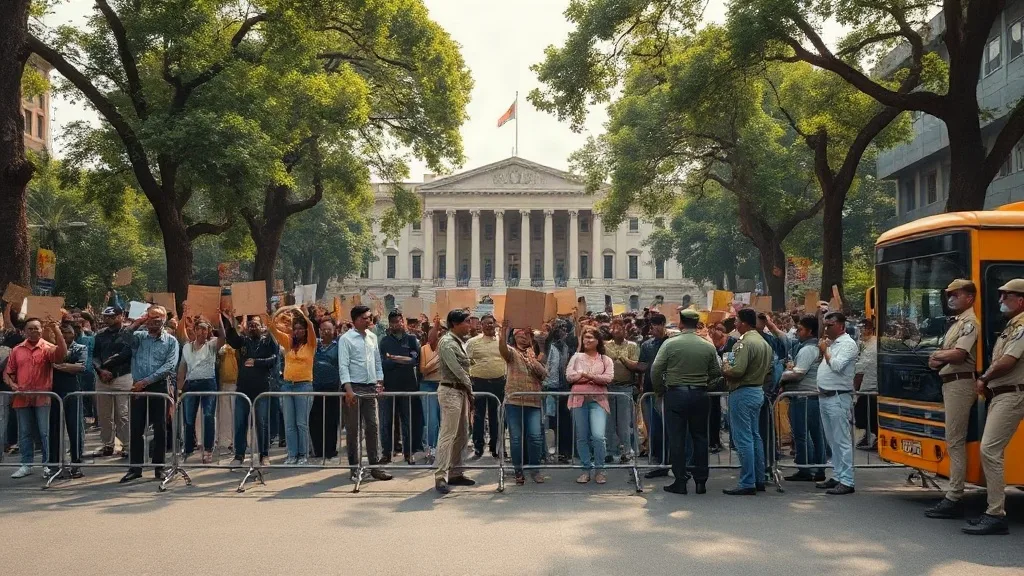
BENGALURU, India: A day after a protest march in Karnataka's capital ended with more than a hundred people in police custody, the state's Home Minister has moved to draw a line under the episode, saying officers have been directed not to disturb peaceful demonstrators. The statement, carried by Indian media, lands in the middle of a widening argument over how India compiles and cleans its voter lists, an administrative process that has started to look a lot like a political fight.
The sequence of events is simple enough. On the previous day, a group set out to march to the office of the Chief Electoral Officer in Bengaluru, intending to hand over a protest against the Special Intensive Revision, or SIR, of electoral rolls. Police stopped the march and detained more than 100 people, according to reports. The Home Minister's clarification the following day was an attempt to separate the state government's position from the actions of the officers on the ground.
What the Home Minister actually said, and what it means
The instruction, as described, is narrow but pointed: peaceful demonstrations should not be broken up. It is not a blanket permission for any assembly at any location, and it does not erase the detentions that already happened. What it does is signal that the state does not want to be seen as the party that shut down a protest over voter rolls.
That distinction matters in Karnataka, where the Congress government and the Bharatiya Janata Party-led Union government have been trading accusations over the SIR process for months. The state has argued that the exercise risks disenfranchising legitimate voters. The Union government and the Election Commission have framed it as a routine cleanup of duplicate and dead entries.
When a Home Minister says police have been told not to disrupt peaceful demonstrations, three audiences are listening at once. The first is the protesters themselves, who now have an official statement they can hold up if officers try to stop them again. The second is the police force, which receives a public instruction it cannot easily ignore. The third is the political class, which will read the statement as a signal about where the state government wants to stand.
The SIR dispute behind the march
To understand why a march to an electoral officer's door drew a crowd in the first place, it helps to step back. The Special Intensive Revision is a house-to-house verification exercise aimed at updating electoral rolls. Officials visit addresses, confirm who lives there, and flag entries that appear outdated or duplicated. On paper, this is housekeeping.
In practice, the exercise has generated anxiety across several states. Voters have reported that names disappeared from rolls after revisions, that officials visited when nobody was home, or that documents accepted for years were suddenly deemed insufficient. Opposition parties have argued that the burden of proof falls hardest on poor, migrant, and marginalised voters, who are least equipped to chase paperwork.
- Door-to-door verification can miss households where residents work during the day.
- Errors in translation or spelling can push a valid voter into a flagged list.
- Migrants who moved recently may not have updated addresses on record.
- Complaints often surface only after the revision window closes, leaving little time to correct them.
None of this proves bad faith on anyone's part. It does explain why the SIR has become a flashpoint, and why a march to the Chief Electoral Officer's office in Bengaluru was treated by organisers as a last resort rather than a first step.
Why the detentions became the story
Protests are routine in Indian cities. What turns one into a national headline is usually the response to it. In this case, the detention of more than a hundred people shifted attention from the substance of the SIR complaint to the conduct of the police. Once that happens, the original grievance tends to get buried under a debate about the right to assemble.
The Home Minister's statement can be read as an effort to pull the conversation back. By saying police have been directed not to disrupt peaceful demonstrations, the minister is effectively conceding that the optics of the previous day were unhelpful, without admitting that the detentions themselves were wrong.
This is a familiar move in Indian politics, and it is not inherently dishonest. State governments often find themselves caught between the operational instincts of the police, who prefer to prevent marches before they grow, and the political cost of being seen as heavy-handed. A public instruction is one of the few tools a minister has to nudge that balance.
What protesters can and cannot rely on
For anyone planning to demonstrate on this issue, the Home Minister's words are worth reading carefully. They cover peaceful demonstrations. They do not cover marches that block arterial roads, gatherings that defy prohibitory orders, or actions that police assess as a threat to public order. The gap between those categories is where disputes usually live.
Practical advice here is not romantic, but it is useful. Organisers who inform the local police station in advance, keep the route short, and designate marshals tend to have fewer confrontations. Documenting the event with video from multiple angles helps establish what actually happened if a dispute arises later. And when detentions occur, the fastest route out is usually legal representation rather than argument at the spot.
None of this guarantees that a peaceful march will be left alone. It does improve the odds, and it makes the state's stated position easier to hold it to.
The bigger question about voter rolls
Beyond Karnataka, the SIR has become a test case for how India handles the messy reality of its electoral database. The rolls are enormous, frequently inaccurate, and politically sensitive. Cleaning them is necessary. Doing so without quietly removing eligible voters is the hard part.
Some states have experimented with more transparent revision drives, publishing draft rolls early, holding extended correction windows, and allowing digital submissions. Others have moved faster. The difference shows up in complaint volumes, and eventually in court.
What the Bengaluru march revealed is that the SIR is no longer a technical exercise in the public imagination. It is a political question, and it will be contested in the streets as well as in the courts. The Home Minister's instruction to the police is, in that light, less about one march than about how the state intends to manage the next several months.
Frequently asked questions
What is the Special Intensive Revision of electoral rolls?
The SIR is a door-to-door verification drive in which election officials confirm voter details at each address and flag entries that appear duplicate, outdated, or unverifiable. Its stated purpose is to keep electoral rolls accurate. Critics say the process can remove legitimate voters when verification is rushed or poorly documented.
Why were people detained in Bengaluru during the SIR protest?
Reports indicate that more than a hundred people were detained when a group attempted to march to the office of the Chief Electoral Officer in Bengaluru to protest against the SIR. Police typically stop such marches on public order or traffic grounds, and detentions in these situations are usually preventive rather than criminal.
Does the Home Minister's statement mean all protests are now allowed?
No. The instruction as reported is limited to peaceful demonstrations. Marches that block main roads, violate prohibitory orders, or are assessed as a risk to public order can still be stopped. The statement sets a direction for police conduct rather than a blanket legal permission.
What should organisers do to keep a protest peaceful and lawful?
Inform the local police station in advance, keep the route and duration limited, appoint marshals to manage the crowd, and arrange for video documentation. If detentions happen, contact a lawyer immediately rather than arguing with officers at the scene. These steps reduce the chance of confrontation and make it easier to challenge any unnecessary force later.
How can voters check whether their name is on the electoral roll?
Voters can check their status through the Election Commission's online voter services portal using their details, or by contacting the local electoral registration officer. During a revision, it is worth checking periodically rather than once, since entries can be flagged and corrected at different stages of the process.