
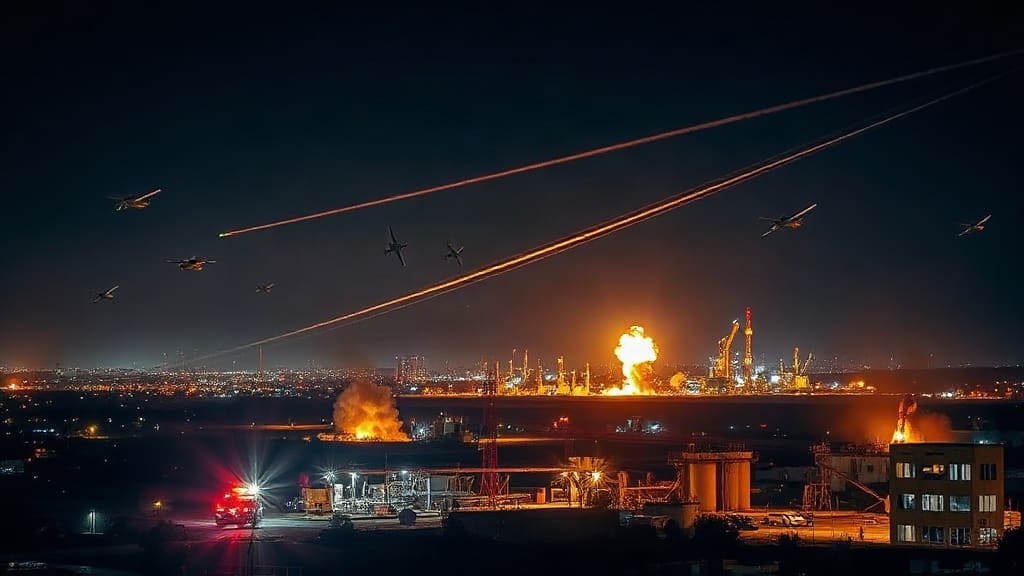
The predawn sky over southern Saudi Arabia lit up with the glow of burning oil infrastructure as a coordinated wave of drones and missiles struck four cities. By sunrise, the scale of the attack was clear: more than 70 people wounded, critical energy facilities damaged, and a conflict that had simmered for years suddenly boiling over into a dangerous new phase. This was not just another cross-border incident. It was a statement, a calculated escalation that has forced Riyadh to promise retaliation and pushed the entire region closer to a wider war.
The Houthi movement, which controls much of Yemen and has long received support from Iran, claimed responsibility for the strikes. But the sheer scope and coordination of the operation suggest a level of sophistication that goes beyond the group's previous capabilities. Targeting four cities in a single night, hitting oil installations with precision, and causing significant casualties indicates either a dramatic improvement in Houthi military competence or direct assistance from external powers. Either way, the message to Saudi Arabia and its allies is unmistakable: the Houthis can now strike deep into the kingdom's economic heartland at will.
What Exactly Happened?
According to initial reports from Saudi officials, the attacks began shortly after midnight and continued for several hours. The cities of Jizan, Abha, Khamis Mushait, and Najran were all hit, with the most severe damage reported at oil facilities near Jizan and Abha. Emergency services rushed to treat the wounded, many of whom suffered burns and shrapnel injuries from explosions. The Saudi-led coalition, which has been fighting the Houthis since 2015, immediately scrambled fighter jets and air defense systems, but the fact that so many projectiles got through raises serious questions about the effectiveness of the kingdom's much-vaunted missile defense capabilities.
What makes this attack particularly significant is its timing and context. For months, there had been tentative diplomatic efforts to de-escalate the conflict. Backchannel talks, mediated by Oman and other regional actors, had raised hopes for a ceasefire. The Houthis had even signaled a willingness to discuss humanitarian issues. But this strike, with its deliberate targeting of economic infrastructure and civilian areas, seems designed to blow up any possibility of negotiation. It is a sharp reminder that in this conflict, military escalation often trumps diplomatic progress.
Why Now? The Strategic Calculus
Understanding why the Houthis chose this moment to escalate requires looking at the broader regional picture. The group has been under increasing military pressure in Yemen, with Saudi-backed forces making slow but steady gains in key areas like Marib and Shabwa. At the same time, Iran, the Houthis' main patron, has been engaged in its own shadow war with Israel and the United States, using proxies across the region to apply pressure. By striking Saudi Arabia directly, the Houthis are not only retaliating for battlefield losses but also serving Iran's broader strategic interests. They are telling Riyadh that its support for anti-Houthi forces comes at a direct cost to Saudi civilians and the Saudi economy.
There is also a domestic political dimension. The Houthis have long relied on a narrative of resistance against foreign aggression to maintain their grip on power. In recent months, that narrative had begun to fray as economic hardship and internal dissent grew. A dramatic attack on Saudi Arabia, especially one that causes significant damage and casualties, is a powerful tool for rallying support and silencing critics. It reminds Yemenis that the Houthis are still capable of striking back against the enemy they blame for the country's suffering.
Riyadh's Response: Retaliation and Its Risks
Saudi Arabia's official response was swift and unambiguous. The kingdom's defense ministry vowed to retaliate, and within hours, airstrikes were reported on Houthi positions in and around the Yemeni capital of Sanaa. But retaliation carries its own risks. The Houthis have proven remarkably resilient to years of Saudi bombing. Their military infrastructure is dispersed, often hidden in civilian areas, making it difficult to destroy without causing significant collateral damage. Each Saudi airstrike that kills civilians provides the Houthis with propaganda material and further fuels anti-Saudi sentiment, not just in Yemen but across the region.
Moreover, escalation has a way of spiraling out of control. The Houthis have previously threatened to target Saudi oil infrastructure more broadly, including the critical facilities in the Eastern Province that produce most of the kingdom's oil. If this latest attack is a preview of what the Houthis are now capable of, the implications for global energy markets are profound. Saudi Arabia is the world's largest oil exporter, and any sustained disruption to its production capacity would send shockwaves through the global economy. Already, oil prices spiked in the hours after the attack, with traders pricing in a higher risk premium for Middle Eastern crude.
The Humanitarian Angle: Civilians Bear the Brunt
Amid the strategic calculations and military responses, it is easy to forget the human cost of this escalation. More than 70 people were wounded in the Saudi strikes, many of them ordinary workers at the oil facilities or residents of nearby neighborhoods. In Yemen, the humanitarian situation is already catastrophic, with millions facing famine and disease. This new round of fighting will only deepen the suffering. Aid agencies have warned that any further escalation could push the country into an even more desperate state, with supply chains disrupted and access for humanitarian workers restricted.
The international community has responded with predictable calls for restraint. The United Nations, the United States, and European powers have all urged both sides to step back from the brink. But these calls have so far had little effect. The Houthis have shown time and again that they are willing to endure enormous suffering in pursuit of their goals, and Saudi Arabia, backed by the United States and other Western powers, has shown no willingness to back down. The result is a deadly stalemate that now threatens to engulf the entire region.
What Happens Next? Scenarios and Implications
Predicting the course of this conflict is a fool's errand, but several scenarios are worth considering. The most immediate concern is a tit-for-tat cycle of retaliation. Saudi Arabia has the military might to inflict significant damage on Houthi-controlled areas, but as noted, the Houthis have proven adept at absorbing punishment. Each round of strikes and counterstrikes raises the risk of miscalculation, a stray missile hitting a civilian target in a way that triggers an even more disproportionate response.
A second scenario involves a broader regional war. Iran's role in this escalation cannot be overstated. If the Houthis are acting as an Iranian proxy, then the attack on Saudi Arabia could be seen as an Iranian attack by extension. This could draw in other regional powers, including Israel, which has its own history of conflict with both Iran and its proxies. The risk of a multi-front war, with Saudi Arabia, Israel, and their allies on one side and Iran and its proxies on the other, is no longer unthinkable.
A third, more hopeful scenario is that this escalation serves as a wake-up call for all parties, forcing them back to the negotiating table. There is a precedent for this. In 2019, a Houthi attack on Saudi oil facilities briefly knocked out half of the kingdom's production capacity, leading to a temporary spike in oil prices. That attack, which was widely blamed on Iran, prompted a flurry of diplomatic activity and eventually led to a partial de-escalation. But the current context is different. The regional landscape is more fragmented, and the incentives for peace are weaker. It would require a major shift in strategy from all sides to turn this moment into an opportunity for diplomacy.
The Energy Market Fallout
One of the most immediate and tangible impacts of the Houthi strikes is on global energy markets. Saudi Arabia is the linchpin of the global oil system, and any threat to its production or export capacity sends ripples through the world economy. In the hours after the attack, Brent crude prices jumped by more than 5%, the largest single-day increase in months. Traders are now pricing in a sustained risk premium, reflecting the possibility of further disruptions.
For consumers, this could mean higher prices at the pump. For governments, it adds another layer of inflationary pressure at a time when many economies are already struggling with rising costs. For Saudi Arabia itself, the attack is a direct challenge to its role as a stable energy supplier, a role it has cultivated carefully over decades. If the kingdom cannot guarantee the security of its oil infrastructure, its influence in global energy markets will be called into question. This is precisely the outcome the Houthis and their Iranian backers are hoping for.
Conclusion: A Dangerous New Chapter
The Houthi strikes on Saudi cities are more than just another incident in a long-running conflict. They represent a significant escalation, a deliberate crossing of a threshold that had previously been avoided. The attack has wounded dozens, damaged critical infrastructure, and brought the region closer to a wider war. It has also exposed the fragility of the diplomatic efforts that had offered a glimmer of hope for peace. As Saudi Arabia prepares its retaliation and the Houthis brace for the response, the people of Yemen and Saudi Arabia are left to wonder whether this latest chapter will bring them any closer to an end or simply deepen the cycle of violence. The world is watching, but so far, watching has not been enough to stop the slide toward catastrophe.
Frequently Asked Questions
What cities in Saudi Arabia were attacked by the Houthis?
The Houthi attacks targeted four cities in southern Saudi Arabia: Jizan, Abha, Khamis Mushait, and Najran. These cities are located near the border with Yemen and have been frequent targets of cross-border strikes throughout the conflict, but this latest wave was notable for its scale and coordination.
How many people were wounded in the Houthi strikes on Saudi Arabia?
According to Saudi officials, more than 70 people were wounded in the overnight attacks. The casualties included workers at oil facilities and residents of nearby areas. Many suffered burns and injuries from explosions, and emergency services were deployed to treat the wounded.
Why did the Houthis attack Saudi Arabia now?
The timing of the attack appears to be linked to several factors, including the Houthis' desire to retaliate for recent battlefield losses in Yemen, Iran's broader regional strategy of pressuring Saudi Arabia, and domestic political considerations within Houthi-controlled areas. The attack also serves to undermine ongoing diplomatic efforts aimed at de-escalating the conflict.
What is Saudi Arabia's response to the Houthi strikes?
Saudi Arabia has vowed to retaliate and has already launched airstrikes on Houthi positions in Yemen. The kingdom's defense ministry has described the attacks as a dangerous escalation and has promised a firm response. However, the effectiveness of Saudi retaliation is uncertain, given the Houthis' resilience to years of bombing.
How will the Houthi strikes affect global oil prices?
The strikes have already caused a spike in oil prices, with Brent crude jumping by more than 5% in the hours after the attack. The market is pricing in a higher risk premium due to concerns about further disruptions to Saudi oil production. If the conflict escalates, oil prices could rise significantly, impacting consumers and economies worldwide.