
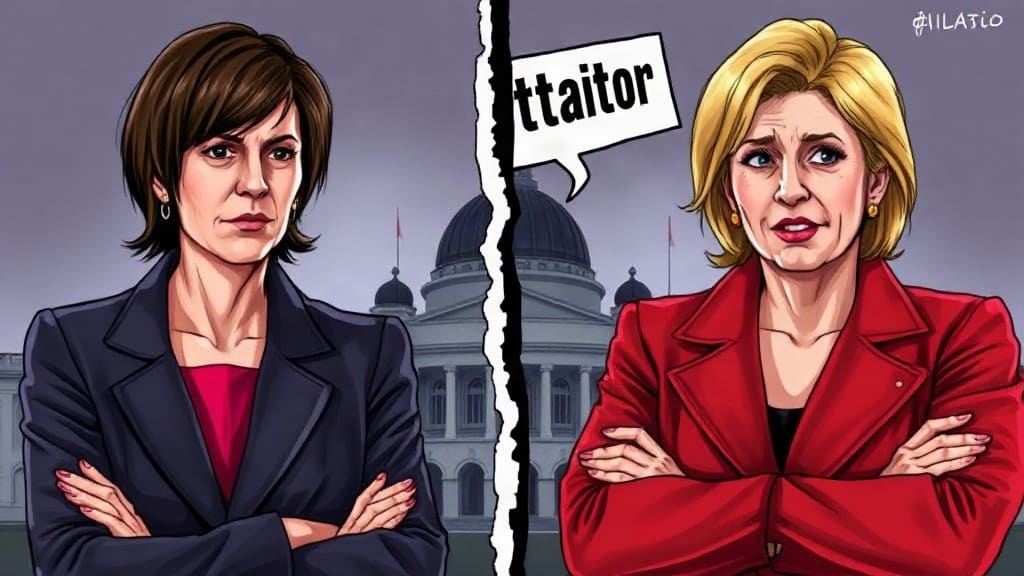
In a fiery escalation of Australia's political culture wars, Tasmanian senator Jacqui Lambie has launched a blistering attack on One Nation leader Pauline Hanson, branding her an "angry little woman" and a "bloody coward" over a controversial cartoon that labels Liberal frontbencher Andrew Hastie a traitor. The clash, which has reverberated through Canberra, centers on a One Nation animated video that repeatedly calls Hastie, a former SAS captain, a traitor for his role in giving evidence against Ben Roberts-Smith in the landmark defamation trial. Lambie, herself an army veteran, has leapt to Hastie's defense, accusing Hanson of showing her "true colours" and refusing to take responsibility for the content published by her party.
The row began when One Nation's official social media channels shared a cartoon depicting Hastie in a mocking light, with the word "traitor" emblazoned across the screen. Hastie, a decorated veteran who served in Afghanistan, has been a vocal critic of Roberts-Smith and was a key witness in the trial that found the former soldier had committed war crimes. The cartoon, which has been viewed thousands of times, has drawn sharp condemnation from across the political spectrum, with many seeing it as an attack on Hastie's military service and integrity.
Lambie, who has never shied away from a fight, took to social media and the airwaves to express her disgust. "Pauline Hanson is showing her true colours," she said. "She's an angry little woman who has no idea what it means to serve. Calling Andrew Hastie a traitor is beyond the pale. He's a bloody hero, and she's a bloody coward for hiding behind a cartoon." The senator's language was raw and unfiltered, reflecting her deep personal connection to the issue. Lambie served in the Australian Army before entering politics and has often spoken about the sacrifices made by veterans. Her decision to defend Hastie, a political opponent from the Liberal Party, has surprised some but underscores her belief that military service transcends partisan divides.
Hanson, for her part, has refused to apologise or remove the cartoon, claiming it is a matter of free speech. In a statement, she said, "I will not be silenced by the political class. Andrew Hastie made his choices, and the Australian people have a right to know the truth." Hanson's supporters have rallied around her, arguing that the cartoon is a legitimate expression of political opinion. However, critics point out that the word "traitor" carries a specific and dangerous weight, particularly when directed at a veteran who served his country.
The controversy has reignited debates about the limits of political speech in Australia, the treatment of veterans, and the role of social media in amplifying divisive content. It also highlights the increasingly personal nature of political discourse, where attacks on character and patriotism have become commonplace. For Lambie, the issue is deeply personal. She has spoken openly about her own struggles with post-traumatic stress disorder and her commitment to supporting veterans. Her decision to take on Hanson, a fellow crossbencher, signals a willingness to break ranks when she believes core values are at stake.
Background: The Roberts-Smith defamation case and Hastie's role
To understand the current clash, it is essential to revisit the defamation trial that ended in June 2023. Ben Roberts-Smith, Australia's most decorated living soldier, sued three newspapers for defamation over articles that accused him of war crimes in Afghanistan. The Federal Court ruled against Roberts-Smith, finding that the articles were substantially true. Justice Anthony Besanko found that Roberts-Smith had murdered unarmed prisoners and civilians, and had bullied and threatened fellow soldiers.
Andrew Hastie, who served alongside Roberts-Smith in the Special Air Service Regiment, was a key witness for the newspapers. He gave evidence that contradicted Roberts-Smith's version of events and supported the claims of other soldiers who had accused Roberts-Smith of misconduct. Hastie's testimony was seen as courageous, given the intense pressure and scrutiny he faced. He has since been a vocal advocate for accountability in the military and has called for a culture change within the defence forces.
Hanson, however, has been a staunch defender of Roberts-Smith, describing him as a "hero" and questioning the integrity of the trial. Her party's cartoon appears to be part of a broader campaign to discredit Hastie and others who spoke out against Roberts-Smith. The One Nation leader has a history of controversial statements and has often positioned herself as a champion of veterans, despite having no military background herself.
Lambie's personal stake in the fight
Jacqui Lambie's response to the cartoon is not merely political; it is deeply personal. Lambie served in the Australian Army for over a decade, and her son is currently serving. She has been a tireless advocate for veterans' issues, including mental health support and compensation for those injured in service. Her own experiences have shaped her worldview and her willingness to speak out against injustice, even when it means clashing with allies.
In her comments, Lambie emphasised the gravity of the word "traitor." "When you call a man who wore the uniform a traitor, you are attacking every man and woman who has served," she said. "Pauline Hanson has no idea what that uniform means. She has no idea what it's like to put your life on the line for your country. And she has no right to question the loyalty of someone like Andrew Hastie."
Lambie's attack on Hanson is also notable for its gendered language. Calling Hanson an "angry little woman" has drawn criticism from some quarters, with accusations of sexism. However, Lambie has refused to back down, arguing that her words reflect Hanson's behaviour, not her gender. "I'm not going to be polite about someone who is spreading lies about a veteran," she said. "If the shoe fits, wear it."
Political fallout and implications
The clash between Lambie and Hanson has wider implications for Australian politics. Both women are influential crossbenchers who have the ability to sway legislation in the Senate. Their feud could complicate negotiations on key issues, including veterans' affairs and national security. It also highlights the challenges of maintaining civility in a political environment that is increasingly polarised.
Prime Minister Anthony Albanese has been drawn into the controversy, with reporters asking for his reaction. While he has not directly commented on the cartoon, he has reaffirmed his government's commitment to supporting veterans and upholding the rule of law. Opposition Leader Peter Dutton, himself a former police officer, has also expressed support for Hastie, calling the cartoon "disgraceful."
The Australian Defence Force has not issued a formal statement, but the controversy has sparked a broader conversation about the treatment of veterans who speak out against wrongdoing. Many veterans' groups have expressed solidarity with Hastie, praising his courage and condemning the cartoon as an attack on the entire military community.
Social media amplification and the role of One Nation
The cartoon was originally posted on One Nation's official social media accounts, where it quickly gained traction. The party has a significant online following, and its content is often shared widely among supporters. The use of animation to convey political messages is not new, but the explicit labelling of a sitting MP as a "traitor" is a significant escalation.
Social media platforms have been criticised for allowing the content to remain online. While the cartoon does not violate most platforms' terms of service, its impact is undeniable. Experts warn that such content can incite harassment and even violence, particularly when directed at individuals who have already faced threats. Hastie has reportedly received increased abuse since the cartoon was published, raising concerns about his safety.
One Nation has a history of using provocative content to generate attention and mobilise its base. Hanson herself has been banned from several social media platforms in the past for violating hate speech policies. However, she remains a powerful force in Australian politics, with a loyal following that appreciates her combative style.
What happens next?
There is no indication that Hanson will back down or remove the cartoon. Her refusal to apologise suggests that she sees the controversy as a political opportunity, a chance to rally her supporters and position herself as a champion of free speech. For Lambie, the fight is far from over. She has vowed to continue speaking out against what she sees as an attack on veterans and the values they represent.
The broader question is whether this incident will lead to any changes in how political parties use social media. There have been calls for stricter regulations, but given the current political climate, consensus is unlikely. In the meantime, the feud between Lambie and Hanson is likely to continue, providing a stark reminder of the deep divisions in Australian society.
As the dust settles, one thing is clear: the cartoon has touched a nerve. It has exposed the raw emotions surrounding Australia's military history, the legacy of the Afghanistan war, and the ongoing struggle for accountability. Whether it leads to meaningful change or simply fades into the background of political noise remains to be seen. But for now, the clash between two of Australia's most outspoken politicians has captured the nation's attention.
FAQ: Understanding the Lambie-Hanson feud and the Hastie cartoon
Why did Jacqui Lambie call Pauline Hanson an "angry little woman"?
Lambie used the phrase in response to a One Nation cartoon that labelled Liberal MP Andrew Hastie a traitor. Lambie, a veteran herself, felt the cartoon was an attack on Hastie's military service and all veterans. She accused Hanson of being a coward for not taking responsibility for the content.
What is the One Nation cartoon about?
The cartoon is an animated video posted on One Nation's social media channels. It repeatedly calls Andrew Hastie a traitor for giving evidence against Ben Roberts-Smith in the defamation trial that found Roberts-Smith had committed war crimes in Afghanistan.
Has Pauline Hanson apologised for the cartoon?
No, Hanson has refused to apologise or remove the cartoon. She claims it is a matter of free speech and has defended the content, saying the Australian people have a right to know the truth.
What was Andrew Hastie's role in the Ben Roberts-Smith case?
Hastie, a former SAS captain, was a key witness for the newspapers in the defamation trial. He gave evidence that supported claims that Roberts-Smith had committed war crimes. His testimony was considered crucial to the court's decision.
Is Jacqui Lambie a veteran?
Yes, Lambie served in the Australian Army for over a decade. She has been a strong advocate for veterans' issues and has spoken openly about her own struggles with PTSD. Her military background informs her passionate defense of Hastie.