
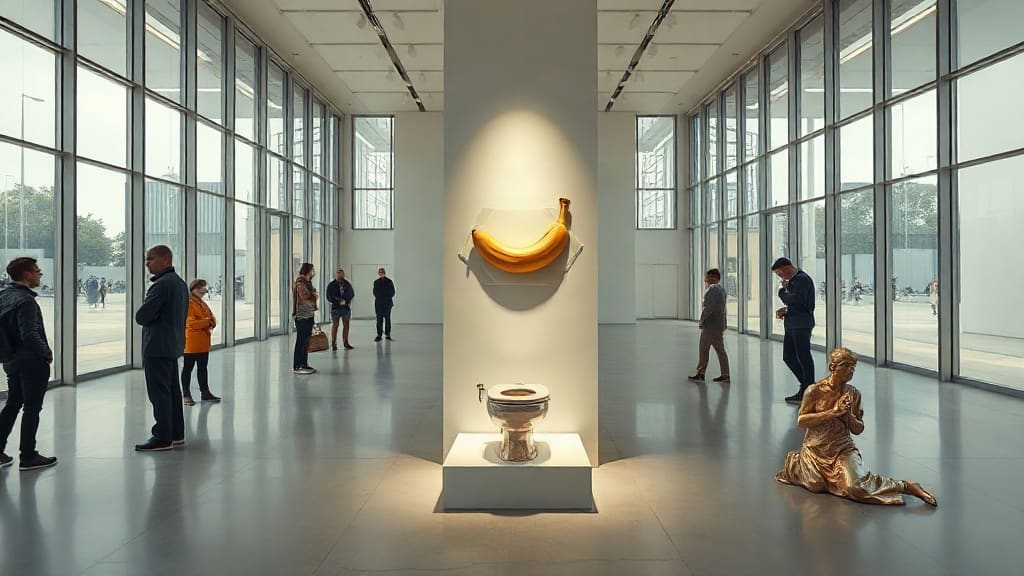
Maurizio Cattelan has spent decades building a reputation as the art world's merry prankster, the man who duct-taped a banana to a wall and sold it for $120,000, who installed a fully functional 18-karat gold toilet in a museum and dared visitors to use it. But as he prepares to open a major new exhibition in Berlin, the Italian artist wants to set the record straight: his work has always been serious. The banana, the toilet, the sculptures of a kneeling Hitler and a fallen pope—they are not jokes. They are, he insists, profound meditations on power, mortality, and the absurdity of human existence.
Speaking at the Neue Nationalgalerie, the Mies van der Rohe-designed glass temple that will host his retrospective, Cattelan is in a reflective mood. Dressed in his usual understated dark attire, he exudes a calm intensity that contrasts with the chaos his art often generates. "There is no need to vandalise anything," he says with a laugh when asked which work might be defaced. "I have already taken care of all that." It is a classic Cattelan response: playful on the surface, but hinting at a deeper, almost nihilistic worldview. For Cattelan, the act of provocation is not an end in itself. It is a tool to force viewers to confront uncomfortable truths about themselves and the world around them.
The Berlin show, titled "Reflections on Power and Morality", brings together some of Cattelan's most infamous works alongside new pieces created specifically for the space. The juxtaposition is deliberate. A hyper-realistic sculpture of Adolf Hitler kneeling in prayer, titled Him, sits not far from a life-size figure of Pope John Paul II struck down by a meteorite. The banana, or rather a new iteration of the original Comedian, is displayed in a vitrine, its absurdity amplified by the solemnity of the museum setting. For Cattelan, these works are connected by a common thread: the fragility of authority and the way society constructs and destroys its icons.
Cattelan's career has been marked by moments of intense public scrutiny. The gold toilet, titled America, was stolen from Blenheim Palace in 2019, just days after it was installed. The theft, which remains unsolved, only added to the work's legend. Was it a commentary on the excesses of the art market, or simply a brazen crime? Cattelan, characteristically, refuses to offer a clear answer. "The toilet was about the idea of value," he says. "What is more worthless than shit? And what is more valuable than gold? When you put them together, you create a paradox that forces people to think." The theft, he suggests, was an unintended but fitting conclusion to the work's narrative. It was, in a sense, the ultimate performance.
The banana, too, has taken on a life of its own. When Comedian debuted at Art Basel Miami Beach in 2019, it sparked a global frenzy. Critics dismissed it as a stunt; collectors clamored to buy editions. One was eaten by performance artist David Datuna, who declared it "delicious." Another was donated to the Guggenheim. The work's value, Cattelan argues, lies not in the banana itself but in the conversation it generates. "The banana is a symbol of the absurdity of the art market," he explains. "But it is also a symbol of the absurdity of all markets, of all value systems. We assign worth to things arbitrarily, and the banana exposes that." In Berlin, the banana is presented alongside documentation of its viral journey, transforming it from a fleeting meme into a historical artifact.
Yet Cattelan bristles at the suggestion that his work is merely about shock. "Provocation is easy," he says. "Anyone can be offensive. The hard part is to be offensive in a way that is meaningful, that opens a door to reflection." He points to Him, the kneeling Hitler, as an example. The sculpture, which has been exhibited in museums and galleries around the world, has provoked both outrage and awe. Some see it as an attempt to humanize a monster; others as a powerful reminder of the banality of evil. Cattelan offers no resolution. "The work is not about Hitler," he insists. "It is about how we deal with history, how we create images of good and evil. The fact that people cannot agree on what it means is the point."
The Berlin exhibition also features a new series of works that Cattelan describes as "quieter" and more introspective. These include a group of marble sculptures depicting sleeping figures, inspired by the artist's own struggles with insomnia. "I have always been interested in the moment between wakefulness and sleep," he says. "It is a state of vulnerability, of surrender. In that state, we are all equal." The sculptures, with their smooth surfaces and closed eyes, offer a stark contrast to the more confrontational pieces in the show. They suggest a softer, more contemplative side to an artist often dismissed as a provocateur.
Critics have long debated whether Cattelan is a genius or a charlatan, a serious artist or a master of the one-liner. The Berlin show is, in many ways, his attempt to settle the question. By bringing together works that span his entire career, he invites viewers to see the connections, the recurring themes, the underlying seriousness. "I have always been serious," he says, his voice dropping to a near whisper. "Even when I am joking, I am serious. The joke is a way to get people to look at things they would rather ignore." It is a statement that could easily be dismissed as another bit of Cattelan irony. But after spending time with the artist and his work, it is hard not to believe him.
The exhibition runs through the summer, and Cattelan is already bracing for the inevitable controversies. Will someone try to steal the banana again? Will the Hitler sculpture spark protests? He shrugs. "I cannot control how people react," he says. "I can only create the conditions for a reaction. And if there is no reaction, then I have failed." For Cattelan, the greatest sin is not provocation but indifference. In a world saturated with images and information, he argues, art must fight to be noticed. And if that means taping a banana to a wall or installing a gold toilet in a palace, so be it. The stakes, he insists, are too high for anything less.
Frequently Asked Questions About Maurizio Cattelan's Berlin Exhibition
Why did Maurizio Cattelan create a gold toilet?
Cattelan created the 18-karat gold toilet, titled America, as a commentary on wealth, excess, and the arbitrary nature of value. By making a functional toilet out of a precious material, he forced viewers to confront the absurdity of assigning worth to objects. The work gained further notoriety when it was stolen from Blenheim Palace in 2019, an event that Cattelan sees as an unintended but fitting extension of the piece's meaning.
What is the meaning behind Cattelan's banana artwork?
Comedian, the banana duct-taped to a wall, is a critique of the art market and the concept of value itself. By presenting a perishable, everyday object as a high-priced artwork, Cattelan exposes the arbitrary nature of economic and cultural worth. The work's viral fame, including its consumption by a performance artist, further amplified its message about the fleeting nature of fame and value.
Why does Cattelan use figures like Hitler and the Pope in his art?
Cattelan uses controversial historical and religious figures to explore themes of power, morality, and iconoclasm. His sculpture Him, depicting a kneeling Hitler, challenges viewers to confront the complexities of evil and the ways societies construct and deconstruct heroes and villains. Similarly, his sculpture of Pope John Paul II struck by a meteorite questions the vulnerability of even the most revered figures.
How does Cattelan respond to accusations that his work is just a prank?
Cattelan insists that his work is deeply serious, even when it appears humorous or provocative. He argues that humor is a tool to engage audiences and force them to confront difficult truths. For Cattelan, provocation is only meaningful if it leads to reflection and dialogue, not just shock for its own sake.
What can visitors expect from the Berlin exhibition?
The Berlin exhibition at the Neue Nationalgalerie offers a comprehensive look at Cattelan's career, featuring both iconic works like the banana and the gold toilet and new, more introspective pieces. The show is designed to highlight the underlying themes of power, mortality, and absurdity that run through all of his work, presenting a more nuanced view of an artist often dismissed as a mere prankster.