
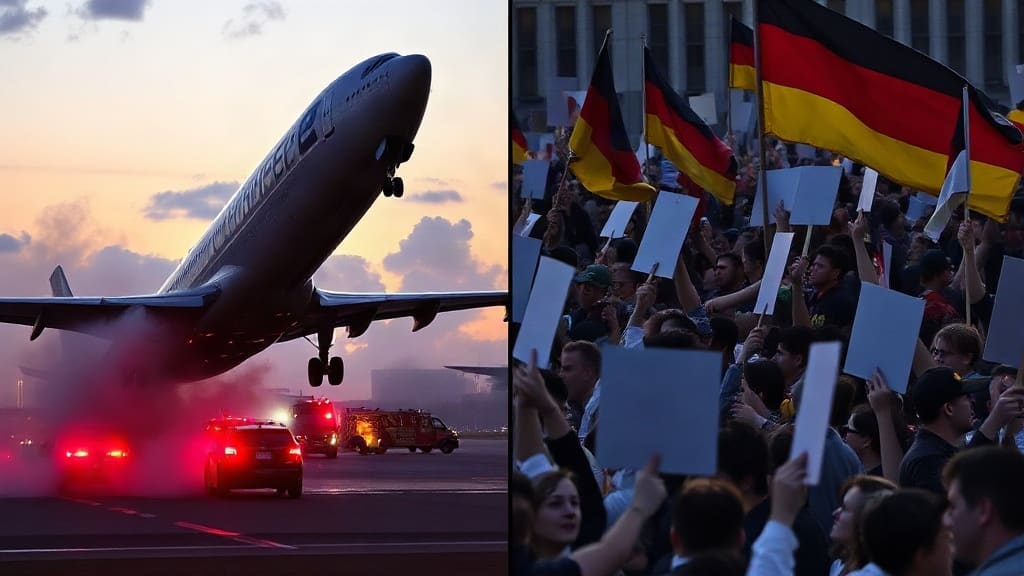
It has been a week of jarring headlines. On one side of the Atlantic, a routine cargo flight turned into a tragedy at Miami International Airport, claiming five lives and leaving a community in shock. On the other, a political earthquake in Germany saw the far-right Alternative for Germany (AfD) secure a landmark victory in a state election, raising urgent questions about the country's democratic direction. These two events may seem unrelated at first glance, but both force us to confront uncomfortable truths about safety, politics, and the systems we rely on.
What Happened at Miami International Airport
In the early hours of the morning, a cargo plane crashed shortly after takeoff from Miami International Airport, bursting into flames and sending plumes of black smoke into the sky. Emergency crews rushed to the scene, but the intensity of the fire made rescue efforts extremely difficult. Authorities later confirmed that all five people on board had died. Several individuals on the ground were also injured, though their conditions have not been fully disclosed.
The aircraft, operated by a commercial cargo carrier, was reportedly carrying a full load of freight. While the exact cause of the crash remains under investigation, early reports suggest a possible mechanical failure or loss of control during the climb. The National Transportation Safety Board (NTSB) has dispatched a team of investigators to Miami, and the Federal Aviation Administration (FAA) is cooperating fully. The runway where the crash occurred was temporarily closed, leading to significant flight delays and cancellations throughout the day.
Witnesses described a harrowing scene. "I saw a huge fireball, then the ground shook. It was terrifying," said one airport worker who asked not to be named. Another bystander captured video showing thick smoke billowing from the wreckage. The airport's emergency response was swift, but the damage had already been done. This tragedy serves as a stark reminder of the risks inherent in air travel, even for cargo operations that often operate away from public attention.
The victims' identities have not yet been released, pending notification of their families. The airline involved has expressed deep sorrow and pledged full cooperation with investigators. In the coming weeks, the focus will shift to understanding what went wrong and preventing a similar incident in the future. For now, the Miami community mourns, and the aviation industry braces for another round of safety scrutiny.
The Far-Right Victory in Germany
Meanwhile, across the Atlantic, Germany is grappling with a political result that many had hoped was unimaginable. The Alternative for Germany (AfD), a party widely described as far-right and under surveillance by German intelligence, has won a state election for the first time in the country's post-war history. The victory, in the eastern state of Thuringia, has sent shockwaves through the political establishment and raised alarm among civil society groups.
The AfD's success did not come out of nowhere. The party has been gaining ground for years, particularly in the former East German states where economic stagnation, demographic decline, and a sense of being left behind by national politics have fueled resentment. The AfD's platform, which combines anti-immigrant rhetoric, euroscepticism, and a rejection of mainstream climate policies, has resonated with a significant portion of the electorate. In Thuringia, the party's lead candidate, Björn Höcke, is a controversial figure known for his extreme views and repeated use of Nazi-era slogans.
The election result has profound implications. While the AfD did not win an outright majority, it is now the largest party in the state parliament. Other parties have refused to form a coalition with the AfD, a stance known as the "firewall," but the practical challenges of governing without the AfD's participation are immense. The situation is further complicated by the fact that no other party has a clear path to a stable majority. This could lead to political paralysis or, in a worst-case scenario, a breakdown of the firewall itself.
Reactions from across Germany and Europe have been swift. Chancellor Olaf Scholz called the result "bitter" and urged democratic parties to stand together. Human rights organizations and Jewish groups have expressed deep concern, citing the AfD's history of downplaying the Holocaust and its anti-democratic tendencies. The victory has also emboldened far-right movements in other European countries, who see it as a sign of growing momentum. For many Germans, the result is a painful reminder of the country's history and a warning about the fragility of democratic norms.
Why These Events Matter Together
At first glance, a plane crash in Miami and an election in Germany have little in common. But both events reveal underlying vulnerabilities in our modern world. The Miami crash underscores the importance of rigorous safety standards and the need for constant vigilance in aviation. The German election highlights the dangers of political polarization and the appeal of simplistic answers to complex problems. Both remind us that systems we take for granted, whether transportation infrastructure or democratic institutions, can be shaken by sudden shocks.
Moreover, both events have immediate and long-term consequences. In Miami, the crash will likely lead to new safety recommendations and possibly regulatory changes. In Germany, the AfD's victory will test the resilience of the country's political culture. The outcomes of both will be watched closely by people around the world, as they carry lessons for other countries facing similar challenges.
The human cost of the Miami crash is immediate and tragic. Five lives lost, families shattered, and a community reeling. The political cost of the AfD's victory is less tangible but no less real: a potential erosion of democratic values, a normalization of extremist rhetoric, and a deepening of social divisions. Both events demand a response that is thoughtful, measured, and grounded in facts rather than fear.
What Comes Next
In the coming days, investigators in Miami will work to determine the cause of the crash. They will examine the aircraft's maintenance records, the crew's training and experience, and the weather conditions at the time of takeoff. The NTSB's final report could take months or even years, but preliminary findings may be released sooner. In the meantime, the aviation community will be watching closely, as any systemic issue could have implications for cargo operations worldwide.
In Germany, the political fallout is just beginning. The AfD's victory in Thuringia is a wake-up call for the mainstream parties, who must now find a way to address the grievances that have driven voters to the far right without compromising their own principles. The firewall against the AfD will be tested, and its survival is far from guaranteed. The international community will also be watching, as Germany's role as a pillar of European stability depends on its ability to manage this challenge.
For the rest of us, these events serve as a reminder that we cannot afford complacency. Safety and democracy are not self-sustaining; they require constant effort and vigilance. The Miami crash and the German election are not isolated incidents but symptoms of broader trends. Addressing them will require not just technical fixes or political maneuvering but a renewed commitment to the values that underpin a safe and just society.
Frequently Asked Questions
What caused the Miami airport crash?
The exact cause of the cargo plane crash at Miami International Airport is still under investigation. Early reports suggest a possible mechanical failure or loss of control during takeoff, but no official determination has been made. The NTSB is leading the investigation and will release findings as they become available.
How did the AfD win the election in Thuringia?
The AfD won the state election in Thuringia by capitalizing on voter dissatisfaction with the mainstream parties, particularly around issues of immigration, economic stagnation, and a perceived loss of national identity. The party's message resonated strongly in the former East German state, where many feel left behind by national politics.
Will other parties form a coalition with the AfD?
No. All other major parties in Germany have ruled out forming a coalition with the AfD, maintaining a "firewall" against the far-right party. However, this stance may lead to political instability, as no other coalition has a clear majority. The situation is fluid and could change in the coming weeks.
What are the implications of the AfD's victory for Germany and Europe?
The AfD's victory is a significant political shift that could undermine democratic norms in Germany and embolden far-right movements across Europe. It also poses a challenge to Germany's traditional role as a stable, centrist power in the European Union. The long-term implications will depend on how other parties and civil society respond.
Are cargo plane crashes common?
Cargo plane crashes are relatively rare, but they do occur. According to aviation safety data, cargo operations have a higher accident rate per flight hour than passenger operations, partly due to older aircraft, different operational pressures, and less stringent oversight in some regions. However, overall aviation safety has improved significantly in recent decades.