
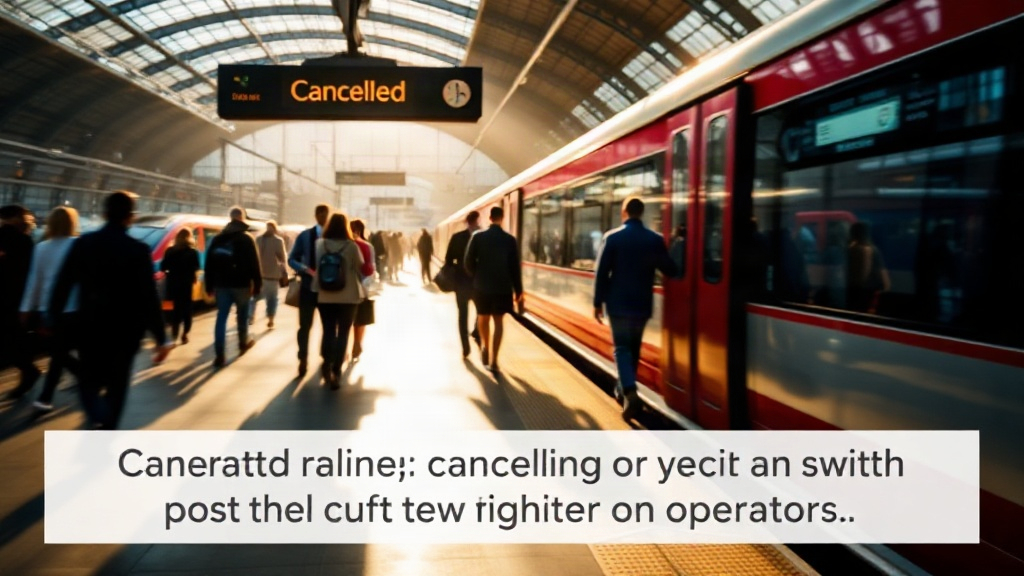
For years, the moment you saw the word 'cancelled' on a departure board, a familiar knot of anxiety tightened. If you had an advance ticket for a specific train, you were often stranded, forced to buy a new ticket or wait hours for the next service from the same operator. From Sunday 20 September 2026, that frustration becomes a thing of the past. The government has announced that rail passengers will have the automatic right to switch operators for free when their train is cancelled, ending a patchwork of confusing rules that have long favoured train companies over travellers.
The change, described by ministers as a 'commonsense change', means you can simply board the next available service run by any operator to complete your journey, without paying extra or facing penalty fares. It applies to all ticket types, including the often-restrictive advance fares, and covers any point during your journey where a cancellation disrupts your plans.
Why this change was long overdue
Until now, the UK rail network operated under a fragmented ticketing system. If you bought a ticket for one operator and your train was cancelled, you were typically only allowed to travel on the next train run by that same company. This could leave you waiting for hours on routes where multiple operators run services, such as the West Coast Main Line or the cross-country routes through Birmingham. The alternative was to buy a new ticket, often at a much higher walk-up fare, and then attempt to claim a refund on the original ticket. It was a process that penalised passengers for a failure that was not their fault.
The new rule removes that burden entirely. Passengers first, not shareholders is the clear message. You no longer need to check the terms and conditions of your ticket or worry about which company operates the train. If your train is cancelled, you can walk over to the next platform and board the next train that gets you to your destination, regardless of the operator.
How the new rule works in practice
The mechanics are straightforward. When your train is cancelled, you are automatically entitled to use any other operator's services to complete your journey. This includes:
- Taking a different operator's train on the same route, even if that operator does not normally accept your ticket type.
- Using a longer or alternative route if necessary to reach your destination, provided it is reasonable in the circumstances.
- Claiming compensation for delays under the existing Delay Repay scheme, in addition to the right to travel on another operator.
There is no need to seek permission from station staff or obtain a new ticket. Simply board the next available train and explain the situation if asked by an inspector. In practice, operators are expected to brief their staff to accept tickets from other companies when a cancellation is shown on their systems. The industry body, Rail Delivery Group, has updated its guidance to ensure a consistent approach across the network.
What about advance tickets and seat reservations?
One of the biggest frustrations for passengers has been the restriction on advance tickets. These are often the cheapest fares, but they tie you to a specific train and operator. If that train is cancelled, the old rules left you in a bind. Under the new policy, those restrictions vanish the moment a cancellation occurs. You can use your advance ticket on any operator's train that serves your route, even if it is a peak-time service that would normally require a much more expensive ticket.
Seat reservations, however, do not transfer. If you had a reserved seat on the cancelled train, you will not automatically have one on the alternative service. You can sit in any unreserved seat, and if the train is full, you may need to stand. This is a minor inconvenience compared to the previous situation, but it is worth noting for long journeys.
What if my train is delayed but not cancelled?
The new rule applies specifically to cancellations. If your train is delayed but still runs, you may still be able to use another operator if you will miss a connection or arrive significantly late, but this is not automatic. In such cases, you should speak to staff or check the operator's policy. The government's focus has been on cancellations, where the disruption is clear-cut. However, many operators already allow flexibility during severe delays, and the new rule is likely to encourage a more generous interpretation across the board.
What does this mean for the future of rail travel?
This change is part of a broader shift towards a more passenger-friendly railway. The government has been under pressure to simplify fares and improve reliability, and this announcement is a tangible step in that direction. It removes a significant source of stress and financial risk for travellers, and it aligns the UK with practices in many European countries where tickets are valid on any operator when disruption occurs.
For passengers, the practical benefit is immediate. You can book the cheapest advance ticket without fearing that a cancellation will leave you stranded or out of pocket. For operators, it means they must cooperate more closely during disruption, sharing capacity and information to get passengers moving. It is a clear signal that the interests of passengers are being put ahead of the commercial interests of individual train companies.
What you should do if your train is cancelled
If you find yourself facing a cancellation, here is a simple checklist to follow:
- Check the departure boards or your app for the next available train to your destination, regardless of operator.
- Board that train and find a seat. If asked, explain that your original train was cancelled and show your ticket.
- If you had a seat reservation, remember it does not carry over, so look for unreserved seating.
- Keep your original ticket and any receipts, as you may still be entitled to Delay Repay compensation if you arrive late.
- If you encounter any problems, ask to speak to a supervisor or contact the operator's customer service later. The new rule is clear, and you should not be penalised.
Frequently asked questions
Does the new rule apply to all ticket types?
Yes, it applies to all tickets, including advance, off-peak, and anytime fares. The key condition is that your original train must be cancelled. If it is cancelled, your ticket becomes valid on any operator's service to complete your journey.
Can I use another operator if my train is delayed but not cancelled?
Not automatically. The new rule is specifically for cancellations. If your train is delayed, you may still be allowed to use another operator if the delay is significant or you will miss a connection, but this is at the discretion of staff. It is best to ask before boarding.
What if I have a seat reservation on the cancelled train?
Your seat reservation does not transfer to the alternative service. You can sit in any unreserved seat, but you may have to stand if the train is full. The right to travel is what matters, not the seat.
Will I still be able to claim compensation for the delay?
Yes. The right to switch operators is separate from compensation schemes like Delay Repay. If you arrive at your destination late because of the cancellation, you can still claim compensation according to the operator's policy, provided you meet the usual conditions.
Does this apply across the whole of the UK?
The announcement covers rail services in Great Britain. Northern Ireland has a different rail system, but the principle is likely to be adopted there as well. For most passengers in England, Scotland, and Wales, the rule applies from 20 September 2026.